Sorry I have been AWOL. Everything is fine here. We have been having fun, playing outside in the water a lot. The other day, I spent a couple of hours outside in the scorching morning heat cleaning up some flower beds while the boys played in the hose. Every once in a while I had to asked them to spray me because, otherwise, I would not have been able to stay out as long. It has been very very hot here...around the 100 to 103 ish mark and that does not include the heat index.
We finally got a break this morning and we had a cool front come through so it only got into the low 90's today but there was much less humidity so it really felt much cooler.
Anyway, not much new going on around here. Just staying busy with summer and trying to catch up on a few things and I was also reading a book so that took me a way for a couple of days. My sister gave the boys some books for when they are a bit older so I was putting them away yesterday morning and started reading The Swiss Family Robinson to see if it was too old for them (it was). Anyway, I got interested in it because I had never read it before. I was already planning to make my weekly jaunt to the library for the boys anyway so I also found the adult version of The Swiss Family Robinson while I was there. I finished it today. What a wonderful book that was! It was written in such a sweet way that it just made me want to be part of that wonderful family, stranded on that beautiful island with them:). I really enjoyed it and was not quite ready to be finished with it. This is one of the things I love about having children. I get to read all of the books that I missed when I was growing up.
Nick has caught a summer cold and I am wondering if anyone else is going to catch it. He still keeps going like the energizer bunny, although I can tell he is not quite as agreeable at times.
Anyway, that's it for tonight. Hope you had a good weekend.
Sunday, June 28, 2009


Saturday, June 20, 2009
June 20, 2009
First, some updated close ups of the boys. Haven't they changed? They are both little brownies from spending so much time outside.
 Here is Nick, helping to put away the silverware.
 And then, working a puzzle. He normally wakes up before Ben, hence the P.J.'s pics.

 Here is a picture of both of our cats looking out of the window at a little rabbit. You can see the rabbit too, although you may have to click on the picture to enlarge it.
 We finally painted our paper mache art work.
 Here is Ben on the top of the jungle gym, getting ready to jump down and Nick is getting ready to climb up.
 Ben is dropping to the ground.
 Now Nick is dropping to the ground.
 Ben climbing up the outside and Nick climbing the inside.
 A photo op break.
 They were in a silly mood.
 Climbing up together.
 Ben is trying to learn how Nick flips over backward as he jumps down.
 Here he goes. He was too fast and I didn't catch the landing.
 Both boys hanging from the inside.
 And trying to climb up to flip over.
 Nick hanging. Ben already landed on the ground.
 Ben climbing up to do a flip.
 Heals over head and away we go. They are too fast for me. I didn't catch the next step.
 Putting the ball into the spray thingy.
 It is really neat to see how the ball stays on the water so long.
 Still going up. It stays there for the longest time.
 Boys in pool doing lots of pouring.
 Photo op break.
 I think Ben was pretending to eat something.
 This is what the pool looked like today.

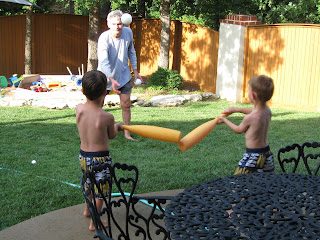
Playing baseball with dad. Nick hit the ball.
 And Ben hit the ball.
 Here is the follow through.
 Dad had just finished some yard work. We have a lefty and a righty.
 Hope you enjoyed picture Saturday! Happy Father's Day!

 Here is Nick, helping to put away the silverware.
 And then, working a puzzle. He normally wakes up before Ben, hence the P.J.'s pics.
 Here is a picture of both of our cats looking out of the window at a little rabbit. You can see the rabbit too, although you may have to click on the picture to enlarge it.
 We finally painted our paper mache art work.
 Here is Ben on the top of the jungle gym, getting ready to jump down and Nick is getting ready to climb up.
 Ben is dropping to the ground.
 Now Nick is dropping to the ground.
 Ben climbing up the outside and Nick climbing the inside.
 A photo op break.
 They were in a silly mood.
 Climbing up together.
 Ben is trying to learn how Nick flips over backward as he jumps down.
 Here he goes. He was too fast and I didn't catch the landing.
 Both boys hanging from the inside.
 And trying to climb up to flip over.
 Nick hanging. Ben already landed on the ground.
 Ben climbing up to do a flip.
 Heals over head and away we go. They are too fast for me. I didn't catch the next step.
 Putting the ball into the spray thingy.
 It is really neat to see how the ball stays on the water so long.
 Still going up. It stays there for the longest time.
 Boys in pool doing lots of pouring.
 Photo op break.
 I think Ben was pretending to eat something.
 This is what the pool looked like today.
Playing baseball with dad. Nick hit the ball.
 And Ben hit the ball.
 Here is the follow through.
 Dad had just finished some yard work. We have a lefty and a righty.
 Hope you enjoyed picture Saturday! Happy Father's Day!
Friday, June 19, 2009
June 19, 2009
The boys and I have had a big day today. We left the house this morning around 10:00ish to go mail Father's day cards to Papa. After that, I really didn't have any big plans but had been wanting to look around in my favorite teacher's store, The Apple Tree, so we headed in that direction. We looked at everything and the boys got to play with a few toys they had out, which was great because it gave me some ideas for birthday gifts in the fall. They each picked out a puzzle and it took them a long time to make up their minds.
Then we decided to go out to eat for lunch at Chick-fil-a. We had a good lunch and they got to play and they each got a balloon, which is always a big hit around here.
Then we went by the pottery painting place to see if our Father's gifts were ready and they were so we got to pick them up and they came out great. Ben and Nick each painted a small plate. I painted the background around the edges so that there would be color all over the plate and then they went to town and painted other colors all over the plate. When they were done painting we put their hand print in the middle of the plate. I also used the paints that are raised up (not sure what they are called) and painted Happy Father's Day around the top of the plate and 2009 around the bottom of the plate and then I wrote each child's name next to his hand print. I thought they really came out wonderful. I wrapped them in a box but had not had a chance to hide it before the dad got home from work and the boys were so excited to help him open it that they went ahead and opened it right away. The dad was very happy with his gifts and thought they were very well done, so that was nice.
We didn't make it back home in time to take naps and, wow, what a mistake that was (crying and whining about every little thing). Suffice it to say that things were not very pleasant around here this evening and the boys went to bed early.
I have to share this because I think it is pretty amazing. This morning, I was reading the next steps in the book I am following (loosely) on teaching the boys to read. The next step was writing small words on index cards so I did some of them and showed them to Ben, since he has been working on his blending of letter sounds and seems to be catching on quickly. These are the words I showed him and he sounded each one out, one time, and then said the word: am, an, at, ad, rat, mat, hat, cat, pat, fat, sat, bat. These are the only ones I had written out so far and he didn't miss any of them. When he finished, he said he was tired of this and he got down to go play. (He is 3.75 years old; he will be 4 years old at the end of September.)
Nick is funny. He was up first and was sitting next to me at the counter finishing his breakfast when I was writing the words on the index cards. I started going over a few of the two letter words with him but he was not very interested. He gave a half-hearted effort on one or two and that was about it. But then, when I was going over them with Ben and Ben was getting positive feedback, Nick was all "Me too; I want to do it!". He made an effort to sound out one word and then he was happy and went on about his business. He has picked up a lot purely from wanting to keep up with Ben or to be included in whatever Ben might be doing.
When we are learning phonics or numbers, we do things in very short spurts but they sure pick up a lot in a short amount of time. I have never pushed them. I will introduce something, a new game or something, or ask them if they want to do such-and-such. If they respond positively, we do it until they are done and then we move on. We really have done very little over the past month or two, although they still play with their Leap Frog word maker toy, which is an awesome toy. They have learned a lot from this toy and also from the Leap Frog Word DVD (can't remember the exact name) and the little "computers" that we have. They call them computers but they are just average toys that teach letters, letter sounds and spelling.
Another neat thing that I noticed just the other day is that both boys can now count to 20 without skipping numbers. Also, they can count that many items, which I think is pretty good. This morning they both wanted to do some dot-to-dot books. Nick had the alphabet one and Ben had the numbers one and they were both doing them very well. I was impressed. Clearly they are both very bright little boys... and they are growing up so fast. It really blows my mind.
Nick is still a very coordinated, athletic little guy. I think I might have already said this but he was swinging from one arm, while hanging from the jungle gym thing the other day. I was so surprised.
Gotta go. Hope you had a Happy Friday!
Then we decided to go out to eat for lunch at Chick-fil-a. We had a good lunch and they got to play and they each got a balloon, which is always a big hit around here.
Then we went by the pottery painting place to see if our Father's gifts were ready and they were so we got to pick them up and they came out great. Ben and Nick each painted a small plate. I painted the background around the edges so that there would be color all over the plate and then they went to town and painted other colors all over the plate. When they were done painting we put their hand print in the middle of the plate. I also used the paints that are raised up (not sure what they are called) and painted Happy Father's Day around the top of the plate and 2009 around the bottom of the plate and then I wrote each child's name next to his hand print. I thought they really came out wonderful. I wrapped them in a box but had not had a chance to hide it before the dad got home from work and the boys were so excited to help him open it that they went ahead and opened it right away. The dad was very happy with his gifts and thought they were very well done, so that was nice.
We didn't make it back home in time to take naps and, wow, what a mistake that was (crying and whining about every little thing). Suffice it to say that things were not very pleasant around here this evening and the boys went to bed early.
I have to share this because I think it is pretty amazing. This morning, I was reading the next steps in the book I am following (loosely) on teaching the boys to read. The next step was writing small words on index cards so I did some of them and showed them to Ben, since he has been working on his blending of letter sounds and seems to be catching on quickly. These are the words I showed him and he sounded each one out, one time, and then said the word: am, an, at, ad, rat, mat, hat, cat, pat, fat, sat, bat. These are the only ones I had written out so far and he didn't miss any of them. When he finished, he said he was tired of this and he got down to go play. (He is 3.75 years old; he will be 4 years old at the end of September.)
Nick is funny. He was up first and was sitting next to me at the counter finishing his breakfast when I was writing the words on the index cards. I started going over a few of the two letter words with him but he was not very interested. He gave a half-hearted effort on one or two and that was about it. But then, when I was going over them with Ben and Ben was getting positive feedback, Nick was all "Me too; I want to do it!". He made an effort to sound out one word and then he was happy and went on about his business. He has picked up a lot purely from wanting to keep up with Ben or to be included in whatever Ben might be doing.
When we are learning phonics or numbers, we do things in very short spurts but they sure pick up a lot in a short amount of time. I have never pushed them. I will introduce something, a new game or something, or ask them if they want to do such-and-such. If they respond positively, we do it until they are done and then we move on. We really have done very little over the past month or two, although they still play with their Leap Frog word maker toy, which is an awesome toy. They have learned a lot from this toy and also from the Leap Frog Word DVD (can't remember the exact name) and the little "computers" that we have. They call them computers but they are just average toys that teach letters, letter sounds and spelling.
Another neat thing that I noticed just the other day is that both boys can now count to 20 without skipping numbers. Also, they can count that many items, which I think is pretty good. This morning they both wanted to do some dot-to-dot books. Nick had the alphabet one and Ben had the numbers one and they were both doing them very well. I was impressed. Clearly they are both very bright little boys... and they are growing up so fast. It really blows my mind.
Nick is still a very coordinated, athletic little guy. I think I might have already said this but he was swinging from one arm, while hanging from the jungle gym thing the other day. I was so surprised.
Gotta go. Hope you had a Happy Friday!
Thursday, June 18, 2009
June 18, 2009
Today we hung out at home all day. I love days like that, especially after we have had a few days running around. I worked on planting a crepe myrtle (flowering bush) in a tough spot, while the boys played, riding their bikes and scooters on the drive way, pulling each other in their wagon and riding their little cars...oh, and also sweeping. It was still relatively cool outside and they were having fun.
Anyway, I was just finishing up when our friends showed up to play. We had planned a play date but they had canceled because my friend, who is pregnant, was not feeling up to par. They ended up deciding to come over after all and couldn't reach us so they drove over to see if we were outside. (They only live one mile away.) We were outside and happy to have company. I was covered in dirt, mud and sweat however, we are the kind of friends that such things just don't matter:). My friend and I enjoyed visiting and the kids all had a great time playing.
After they left, it was time for lunch and naps and then more playtime outside and dinner. Otherwise, not much new going on around here. The boys are still fun and sweet (most of the time) and busy and funny. The dad/husband is still the most patient person I have ever met, kind, very slow to anger and the best dad/husband ever and we are looking forward to celebrating him this weekend.
Anyway, I was just finishing up when our friends showed up to play. We had planned a play date but they had canceled because my friend, who is pregnant, was not feeling up to par. They ended up deciding to come over after all and couldn't reach us so they drove over to see if we were outside. (They only live one mile away.) We were outside and happy to have company. I was covered in dirt, mud and sweat however, we are the kind of friends that such things just don't matter:). My friend and I enjoyed visiting and the kids all had a great time playing.
After they left, it was time for lunch and naps and then more playtime outside and dinner. Otherwise, not much new going on around here. The boys are still fun and sweet (most of the time) and busy and funny. The dad/husband is still the most patient person I have ever met, kind, very slow to anger and the best dad/husband ever and we are looking forward to celebrating him this weekend.
Tuesday, June 16, 2009
June 16, 2009
First of all, I must apologize for not finishing up the book chapters in a timely fashion. I do intend to do this, I have just been temporarily side tracked for a short time. I actually have the book sitting next to me right now and had intended to write a chapter summary this evening but time has slipped by to quickly on me. The problem is that I am reading a novel right now so it is taking some of my free time, which I have very little of to begin with:). I will finish it soon and get back to it.
Today was dentist day. The boys had their six month check up today and it went exceptionally well. They both handled it like champs. When their names were called, N looked at me and said he wanted me to go in with him but then the lady and I both said something about him being a big boy or something or another. Both boys marched right in with no problem at all after that. I sat in the waiting room, praying for the boys, reading a book and praying some more. I was hoping and praying they would have have a good experience. At one point I heard a child crying/whining so I looked through the window but it was another child. My two were each lying in their chair with mouth open, like model patients. After B had his cleaning, he thought they were finished so he came out to see me. Soon after the lady came out and told him the dentist still needed to look at his teeth. I think he was a bit confused. I should have explained that ahead of time. I normally try to remember to set their expectations before we do something new or something we don't do often and I try to describe what will happen in great detail, as I have seen that it seems to really help them and they know better how to behave and what to expect. Anyway, he followed her back in with no complaints. They both had good reports and they were both proud of themselves for being such big boys.
After the dentist, we went out for a bite to eat, kind of as a reward, and they had some playtime at McD's. Then we headed off to find this physical therapy place because I needed to buy another piece of this hard foam stuff to use in my physical therapy torture treatment.
We came home and we all had a nap. I really needed one too as I heard B cry out around 2:30am. He went right back to sleep but he woke up N, who then cried out but then got quiet. So I thought they were both sleeping and then N showed up in our room so I held him for a little while, contemplating whether or not we would be able to sleep with him in our bed, knowing we would not (especially me) but so tired I really did not want to make the trip back upstairs with him. I eventually made myself get up and took him back upstairs. He was perfectly fine with it, although wanted his pull up changed before going back to bed. Before I left the room, he told me that I am his best friend, something he is telling me a lot lately and it warms my heart every time. He also blew me a kiss as I was leaving and I did not realize it so he called me back to do it again and then he was a happy camper.
It is funny that we still sit with the boys until they fall asleep but, if one of them wakes up during the night (pretty much always N, although it happens very seldom) he is fine with me leaving and going back to bed while he goes to sleep by himself. I am always very thankful for that.
After nap, the boys watched a movie and then wanted to go outside and play. They are having a ball this summer in their little swimming pool, the sandbox and also their climbing jungle gym thingy. The dad and I were watching them climb and hang from that thing today and we were amazed at how much upper body strength they have now. They are just growing like crazy.
I have been taking some pictures but the reason I have not posted any lately is because I do not have the right software on my new laptop and I keep forgetting to load it. I'm not even sure where to find it because the husband normally takes things of all things electronic around here. Hopefully we can get it loaded soon.
Saturday night we took the boys to dad's work function, a graduation dinner for the residents. This was not on purpose. The husband and I did not communicate well about it and so we ended up not having a baby sitter that night (oops). But, in the end, I was really glad because it worked out really well, the boys had a nice evening and were very well behaved and we didn't have to spend the extra money for a babysitter (we can spend it on a date night instead:). This was one of those times that I spent some time explaining to them what was going to happen at this event and what it would be like and how they should behave and I also made sure they took a good nap earlier that day. We all enjoyed it and they got to see daddy get up in front of everyone and speak and they enjoyed that. They were wonderful and I was happy to have them with us. Isn't that cool?
Ben saw me cleaning the cat box this morning and said that when he is big, he wants to do that too. I may have to book mark this page and file it in a special folder so I will be sure to remember it when he gets big:).
This has been something that Ben has been saying a lot lately..."when I get big" or "when me get big". He has lots of plans and I need to start writing them all down so I can document them. At dinner tonight, they were both telling us, "So, I went to work today." After that, according to the script, we are suppose to ask what they did at work that day and they end up telling us how many patients they saw that day. The other day, Ben said he was going to be a doctor like daddy when he gets big and Nick said he was going to be a fireman.
Yesterday the boys and I did something special together for Father's Day but I can't tell what we did until after Father 's Day in case said Father happens to read:).
We are staying very busy and spending a lot of time playing outside. The boys are at a great age and I really have no complaints. Are they perfect? Of course not...but then again, neither am I:). Overall, their behavior is pretty good these days and we are getting to do some extra things here and there because I have some extra spending money (the money I earned from the garage sale:).
We are having a fun summer. Hope you are too!
Today was dentist day. The boys had their six month check up today and it went exceptionally well. They both handled it like champs. When their names were called, N looked at me and said he wanted me to go in with him but then the lady and I both said something about him being a big boy or something or another. Both boys marched right in with no problem at all after that. I sat in the waiting room, praying for the boys, reading a book and praying some more. I was hoping and praying they would have have a good experience. At one point I heard a child crying/whining so I looked through the window but it was another child. My two were each lying in their chair with mouth open, like model patients. After B had his cleaning, he thought they were finished so he came out to see me. Soon after the lady came out and told him the dentist still needed to look at his teeth. I think he was a bit confused. I should have explained that ahead of time. I normally try to remember to set their expectations before we do something new or something we don't do often and I try to describe what will happen in great detail, as I have seen that it seems to really help them and they know better how to behave and what to expect. Anyway, he followed her back in with no complaints. They both had good reports and they were both proud of themselves for being such big boys.
After the dentist, we went out for a bite to eat, kind of as a reward, and they had some playtime at McD's. Then we headed off to find this physical therapy place because I needed to buy another piece of this hard foam stuff to use in my physical therapy torture treatment.
We came home and we all had a nap. I really needed one too as I heard B cry out around 2:30am. He went right back to sleep but he woke up N, who then cried out but then got quiet. So I thought they were both sleeping and then N showed up in our room so I held him for a little while, contemplating whether or not we would be able to sleep with him in our bed, knowing we would not (especially me) but so tired I really did not want to make the trip back upstairs with him. I eventually made myself get up and took him back upstairs. He was perfectly fine with it, although wanted his pull up changed before going back to bed. Before I left the room, he told me that I am his best friend, something he is telling me a lot lately and it warms my heart every time. He also blew me a kiss as I was leaving and I did not realize it so he called me back to do it again and then he was a happy camper.
It is funny that we still sit with the boys until they fall asleep but, if one of them wakes up during the night (pretty much always N, although it happens very seldom) he is fine with me leaving and going back to bed while he goes to sleep by himself. I am always very thankful for that.
After nap, the boys watched a movie and then wanted to go outside and play. They are having a ball this summer in their little swimming pool, the sandbox and also their climbing jungle gym thingy. The dad and I were watching them climb and hang from that thing today and we were amazed at how much upper body strength they have now. They are just growing like crazy.
I have been taking some pictures but the reason I have not posted any lately is because I do not have the right software on my new laptop and I keep forgetting to load it. I'm not even sure where to find it because the husband normally takes things of all things electronic around here. Hopefully we can get it loaded soon.
Saturday night we took the boys to dad's work function, a graduation dinner for the residents. This was not on purpose. The husband and I did not communicate well about it and so we ended up not having a baby sitter that night (oops). But, in the end, I was really glad because it worked out really well, the boys had a nice evening and were very well behaved and we didn't have to spend the extra money for a babysitter (we can spend it on a date night instead:). This was one of those times that I spent some time explaining to them what was going to happen at this event and what it would be like and how they should behave and I also made sure they took a good nap earlier that day. We all enjoyed it and they got to see daddy get up in front of everyone and speak and they enjoyed that. They were wonderful and I was happy to have them with us. Isn't that cool?
Ben saw me cleaning the cat box this morning and said that when he is big, he wants to do that too. I may have to book mark this page and file it in a special folder so I will be sure to remember it when he gets big:).
This has been something that Ben has been saying a lot lately..."when I get big" or "when me get big". He has lots of plans and I need to start writing them all down so I can document them. At dinner tonight, they were both telling us, "So, I went to work today." After that, according to the script, we are suppose to ask what they did at work that day and they end up telling us how many patients they saw that day. The other day, Ben said he was going to be a doctor like daddy when he gets big and Nick said he was going to be a fireman.
Yesterday the boys and I did something special together for Father's Day but I can't tell what we did until after Father 's Day in case said Father happens to read:).
We are staying very busy and spending a lot of time playing outside. The boys are at a great age and I really have no complaints. Are they perfect? Of course not...but then again, neither am I:). Overall, their behavior is pretty good these days and we are getting to do some extra things here and there because I have some extra spending money (the money I earned from the garage sale:).
We are having a fun summer. Hope you are too!
Thursday, June 11, 2009
June 11, 2009
Sorry for the lack of posting lately. We have been very busy and I am very tired. Glad tomorrow is Friday. I will start posting again soon. Thanks for your patience.
A couple of cute things, so I don't forget. We were driving the hour and a half to my mom's house yesterday. The boys were listening to their music. Nick was singing, as usual, and then he said, "Come on Ben, sing with me!".
They have been very into the Veggie Tales scene these days and my nephew also gave them two Veggie Tale music CD's yesterday. They were listening to one of the CD's this morning. I put it on at their request and then headed to the bedroom to make my bed. I came back to find they had pulled out chairs from the kitchen table (the CD player is on the kitchen counter) and were sitting there, enjoying their music, while playing with a toy. It was very cute. Later, long after the music had been turned off, I heard Nick singing about carrots, tomatoes and celery as he was walking through the kitchen.
Oh the cuteness. They are so sweet (most of the time:).
A couple of cute things, so I don't forget. We were driving the hour and a half to my mom's house yesterday. The boys were listening to their music. Nick was singing, as usual, and then he said, "Come on Ben, sing with me!".
They have been very into the Veggie Tales scene these days and my nephew also gave them two Veggie Tale music CD's yesterday. They were listening to one of the CD's this morning. I put it on at their request and then headed to the bedroom to make my bed. I came back to find they had pulled out chairs from the kitchen table (the CD player is on the kitchen counter) and were sitting there, enjoying their music, while playing with a toy. It was very cute. Later, long after the music had been turned off, I heard Nick singing about carrots, tomatoes and celery as he was walking through the kitchen.
Oh the cuteness. They are so sweet (most of the time:).
Wednesday, June 03, 2009
June 3, 2009
So today the boys both slept in until almost 8:00. I ended up going upstairs with the intent to wake them up but they were just waking up when I entered their room. Needless to say (but I'll say it:) we were all in a much better mood this morning than we were yesterday morning.
Today we went to the library for story time for the first time. We arrived just as they were starting and the boys didn't quite know what to think. I should have explained it to them a little better I suppose so they would have know more what to expect. They are normally such talkers and singers however they were very quiet during story time, even during the singing parts. They seem to enjoy it, although they were easily distracted by the other kids. We ended up checking out three more audio books and we have to make a trip to the farm next week so we will have a great opportunity to listen to one of them then. We started one today as we left the library and headed to McDonalds (or Old McDonalds, as the boys say, even though I have explained to them many times that it is just McDonalds).
We were looking forward to lunch and some play time at McD's but it was extra packed because it is a rainy day here today and, of course, school is out for the summer. We ate our lunch and then went into the play area and we were only there maybe 5 or 10 minutes when the boys decided they wanted to leave. They didn't like it with so many kids (and I didn't like the noise level). So we headed home and we are now having some quiet time.
The boys have gotten very good about our quiet time. We normally do 45 minutes of quiet time a day now, if they don't need a nap, which they normally do not these days. It is a very pleasant time. Nick is very good about getting a huge pile of books and looking through them, pouring over each picture. Ben tends to get 2 or 3 books and quickly becomes bored with them, after which he sprawls around on the couch, moving in this direction and that, all the while whispering to himself as he pretends something or other. it is very funny to watch and I can hear him whispering now, even though he is on the couch in the other room.
Well, not much more going on around here today. Have a great day!
Today we went to the library for story time for the first time. We arrived just as they were starting and the boys didn't quite know what to think. I should have explained it to them a little better I suppose so they would have know more what to expect. They are normally such talkers and singers however they were very quiet during story time, even during the singing parts. They seem to enjoy it, although they were easily distracted by the other kids. We ended up checking out three more audio books and we have to make a trip to the farm next week so we will have a great opportunity to listen to one of them then. We started one today as we left the library and headed to McDonalds (or Old McDonalds, as the boys say, even though I have explained to them many times that it is just McDonalds).
We were looking forward to lunch and some play time at McD's but it was extra packed because it is a rainy day here today and, of course, school is out for the summer. We ate our lunch and then went into the play area and we were only there maybe 5 or 10 minutes when the boys decided they wanted to leave. They didn't like it with so many kids (and I didn't like the noise level). So we headed home and we are now having some quiet time.
The boys have gotten very good about our quiet time. We normally do 45 minutes of quiet time a day now, if they don't need a nap, which they normally do not these days. It is a very pleasant time. Nick is very good about getting a huge pile of books and looking through them, pouring over each picture. Ben tends to get 2 or 3 books and quickly becomes bored with them, after which he sprawls around on the couch, moving in this direction and that, all the while whispering to himself as he pretends something or other. it is very funny to watch and I can hear him whispering now, even though he is on the couch in the other room.
Well, not much more going on around here today. Have a great day!
Tuesday, June 02, 2009
June 2, 2009 Part 2
Boys who wake up at 6:15 am are not very pleasant to be around by 12:15 pm. I am not sure why they woke up so early but I pray this does not become a habit. Time for naps.
June 2, 2009
Our first ever garage sale went very well. One lady even said it was the most organized garage sale she had ever seen:). We ended up making $427 and sold most of the items. We took the remaining items to the local Good Will office.
It was a lot of work and we ended up not getting to bed the night before until around 11:30. The husband went to sleep right away, as usual, and while I was getting ready to fall asleep I heard a loud thump on the upstairs floor and then heard Nick on the monitor crying and calling to me. I rushed up and he had blood running from his nose. Poor little guy. What a rude awakening, to hit the floor with your nose and then have blood running all over you. I cleaned him up and stayed with him until he was almost back to sleep so it was pretty late when I got to bed. Thankfully, the husband is naturally an early riser so he was up early and moved a bunch of toys and the lawn mower and a couple of other things out of the garage and into the back yard.
I forgot to put the time and date in the paper so we had one guy knocking on our door, asking if this was where the garage sale was, early Friday morning and we had several people show up between 7:00 and 8:00 on Saturday (we were planning to start at 8:00 on Sat.). But the dear husband took care of them while I fed the boys and got ready and I was out there and ready by 8:00am as planned. I think we finally called it a day around 2:00 or 2:30. As the time went by, I started slashing prices all over the place because I didn't want to be left with all of this stuff. Overall, I was very pleased with how much stuff we sold and the husband was pleasantly surprised. He was actually very surprised at how much stuff we had to sell. Both he and my sister were thinking we did not have that much stuff to get rid of. I think my favorite part was going through all of the cabinets, drawers and closets gathering stuff up that we had stored for years and had never used. That felt really good and it feels really good to now have all of that stuff gone.
Most of the time the dad was working on painting our fence while I was manning the garage sale and the boys were either hanging out with me, eating snacks, or playing in the yard or on the driveway. I ended up getting some of their riding toys out and put them in the grass next to the driveway so they could ride them on the driveway if they wanted. So almost everyone who walked up asked if they were for sale. In hindsight, I should have put up a sign indicating they were not for sale.
The boys did very well over all but poor little Ben cried several times because he wanted me to push him on the swing and I couldn't. Other than that, they did pretty well and had a fun day, although a tiring one (for all of us). After we dropped off the items at Good Will, we went out to eat a late lunch.
Well, both boys are sitting in chairs in the living room, looking through their books. I think that is a sign they would like someone to read to them and I am that someone so I must sign off for now. Ta Ta! :).
It was a lot of work and we ended up not getting to bed the night before until around 11:30. The husband went to sleep right away, as usual, and while I was getting ready to fall asleep I heard a loud thump on the upstairs floor and then heard Nick on the monitor crying and calling to me. I rushed up and he had blood running from his nose. Poor little guy. What a rude awakening, to hit the floor with your nose and then have blood running all over you. I cleaned him up and stayed with him until he was almost back to sleep so it was pretty late when I got to bed. Thankfully, the husband is naturally an early riser so he was up early and moved a bunch of toys and the lawn mower and a couple of other things out of the garage and into the back yard.
I forgot to put the time and date in the paper so we had one guy knocking on our door, asking if this was where the garage sale was, early Friday morning and we had several people show up between 7:00 and 8:00 on Saturday (we were planning to start at 8:00 on Sat.). But the dear husband took care of them while I fed the boys and got ready and I was out there and ready by 8:00am as planned. I think we finally called it a day around 2:00 or 2:30. As the time went by, I started slashing prices all over the place because I didn't want to be left with all of this stuff. Overall, I was very pleased with how much stuff we sold and the husband was pleasantly surprised. He was actually very surprised at how much stuff we had to sell. Both he and my sister were thinking we did not have that much stuff to get rid of. I think my favorite part was going through all of the cabinets, drawers and closets gathering stuff up that we had stored for years and had never used. That felt really good and it feels really good to now have all of that stuff gone.
Most of the time the dad was working on painting our fence while I was manning the garage sale and the boys were either hanging out with me, eating snacks, or playing in the yard or on the driveway. I ended up getting some of their riding toys out and put them in the grass next to the driveway so they could ride them on the driveway if they wanted. So almost everyone who walked up asked if they were for sale. In hindsight, I should have put up a sign indicating they were not for sale.
The boys did very well over all but poor little Ben cried several times because he wanted me to push him on the swing and I couldn't. Other than that, they did pretty well and had a fun day, although a tiring one (for all of us). After we dropped off the items at Good Will, we went out to eat a late lunch.
Well, both boys are sitting in chairs in the living room, looking through their books. I think that is a sign they would like someone to read to them and I am that someone so I must sign off for now. Ta Ta! :).
Subscribe to:
Posts (Atom)